"Is there a national championship collegiate athletic program anywhere in the country that can truthfully say all of its recruiting was done entirely within the official guidelines? Just asking."
That's Roger Ebert asking, in his review of Blue Chips, a rhetorical question that most fans of college athletics would rather not consider. Seems like a month doesn't go by without ESPN reporting on alleged recruiting violations at a given school, but it's never front page news and it's always gone after a day. Rules are broken, wrists are slapped, and everyone - fans, coaches, athletes, administrators - moves on to the next season.
This doesn't explain how a movie like Blue Chips was ever made, but it does explain why a movie like Blue Chips (or its cousin, The Program, or its successor, He Got Game) is never discussed, especially around this time of year, when universities spend (and earn) millions of dollars on advertising during March Madness coverage. Commentators talk about "how much these kids love basketball" and "what it means to Coach so-and-so to get to this point in his career", but never could a word be uttered about the money spent and favors called in to create all of those One Shining Moments.
Before there was Up and before there was WALL-E, there was August's Underrated Movie of the Month (UMOTM), *batteries not included. It wasn't until I saw it again recently that I saw how much those two Pixar movies were influenced by it, but even more than that I was reminded why the movie had always existed as a nostalgic favorite in my head.
I thought I'd first seen *batteries not included in the movie theater until I checked its release date. I remember it being summer when I saw it, but according to IMDb it was released on December 18, 1987. Maybe I saw it a discount theater six months later or maybe I just thought it was summer because the movie is set during the summer and the characters sleep with their windows open. In any event, I loved it at first sight, but reading the reviews of it now has made it apparent that was likely because I was seven years old.
Janet Maslin kicked off the criticism in the New York Times: "...everything in the film has been designed in toymaker's terms. That includes the human characters, who are adults only in the way an 8-year-old might imagine them. Children may enjoy this, but their adult escorts will have a harder time....Batteries Not Included isn't the kind of film that prompts questions of any kind...the time for this brand of fantasy may have come and gone." Despite her obsession with marketing motives throughout her review, I never had any *batteries not included toys.
Rita Kempley received the baton in the Washington Post: "Here's my theory: Steven Spielberg was captured by aliens, brainwashed and forced to become their public relations man...Though directed by Matthew Robbins, it is an Amblin Entertainment feature rooted in the Spielbergian credo: Earthlings cannot cope without the little men upstairs...Casting tends to be racist...Perhaps Spielberg and his pawn Robbins want to implant maternal instincts in the collective consciousness...What a strange lesson to teach children -- that they are basically helpless. Batteries is a strange kids' movie, a queer mix of violence and otherworldly benevolence. It might have been a good idea, a story of the vanishing urban neighborhood and gentrification by tycoon. But half-pint aliens to the rescue? It's time E.T. went home." A little tired of Spielberg, eh, Rita?
Even Variety gave it a limp recommendation (with my emphasis in bold): "Batteries Not Included could have used more imaginative juices to distinguish it from other, more enchanting Spielbergian pics where lovable mechanical things solve earthly human dilemmas. Still, it's suitable entertainment for kids...has a good mix of personalities, even if perhaps Elizabeth Pena as an unwed mother may raise some questions in children's minds their parents just as soon would not answer." WOW, how far have we come in 20 years? According to a recent article I read, "a record-breaking 40% of babies born in 2007 had unmarried parents (that's up 25% from 2002)". And you can imagine what that 25% was up from since 1987. But perhaps this is another discussion for another place.
Did any critics praise this movie? Ah yes, trusty Ebert: "Cronyn and Tandy rescue the movie from looking altogether like a retread, and the saucers do their part, too. Designed by Industrial Light & Magic, the visual effects wizards, the saucers swoop and vibrate and blink and purr and even have children...Batteries Not Included is a sweet, cheerful and funny family entertainment. " Alright, so the consensus is that we'd seen this movie before. After all, in the decade prior to this movie audiences had already enjoyed E.T., Close Encounters of the Third Kind, Cocoon, Short Circuit, and Flight of the Navigator, among other sci-fi and/or benevolent alien movies. But just because *batteries not included wasn't a big creative leap for Spielberg and director Matthew Robbins, it doesn't mean it was any less enjoyable than the others. Here are three reasons why this movie deserves more credit, despite the criticism that it was an worn out and altogether empty story:
1.) Old people. - Quick, name the last movie you saw starring actors older than age 70? Anything? What, maybe Gran Torino last year? Away from Her a couple years ago? We're much more likely to see young actors and actresses made up to be old these days, evidenced by The Reader, Benjamin Button and Love in the Time of Cholera (alright, in that they didn't look old so much as just dead). If we've forgotten, the 80's were a huge decade for seniors in Hollywood, primarily led by co-stars and spouses Hume Cronyn and Jessica Tandy in Cocoon, *batteries not included and Cocoon: The Return. Tandy was also in Driving Miss Daisy and Fried Green Tomatoes (ok, that was '91 - close enough).
As Faye and Frank Riley in *batteries not included, Tandy and Cronyn are a delight - she playing the senile but surprisingly witty wife, he playing the cantankerous and anxious husband. They delivered terrific performances here near the end of their respective careers, but you never hear about them because you never hear about this movie.
2.) Outstanding visual effects. - I love the look of this movie, with the warm sepia tones at the beginning and the cool sunset and evening shots throughout. It's a pretty enchanting set (filmed on location in the Lower East Side) to begin with, but the arrival of the "fix-its" cranks the visual goodness up to 11. Spielberg and Lucas and the folks at ILM were in familiar territory here with alien spacecraft and mannerisms, but the fix-its are really a stunning achievement in their own right, as good as anything the team had done to that point. Their movements are fluid and with simple changes in sound and "eye" movement, they really develop their own personalities, including the baby fix-its.
Looking back, *batteries not included was terribly overlooked during awards season. Only two films were even nominated for the Academy Award for Best Visual Effects, with Predator losing out to Innerspace. I'd be more upset if I didn't also love Innerspace.
3.) It accepted - or at least didn't reject - its 1980's identity. - *batteries not included could have been set in the future, or something else could have been changed to make its plot more believable, but it wasn't - it was completely at peace taking place in the 80's. The characters' wardrobes could not be from any other era, the shots of Times Square show a seedy and tourist-unfriendly place, and one of the characters, the former boxer Harry, speaks only in 1980's advertising ("We bring good things to life," "Don't leave home without," "Batteries not included," etc.). Also, one of the best lines of the movie, when Mason is trying to convince his girlfriend not to leave him: "This is the '80s! Nobody likes reality any more!," she exasperatingly scolds him as he she walks out the door. The result of these "period pieces" don't make the movie look dated, they just add to the nostalgia. So there you have it - three reasons to revisit this movie and discover that it should be appreciated for getting a lot of things right, even if it didn't bring anything "new" to the table.
In the spirit of summer, let's head outdoors - The Great Outdoors. What surprises me about July's Underrated Movie of the Month isn't just that it has a Rotten Tomatoes critical rating of 38% (it's not listed on MC), but that the reviews themselves were so harshly negative - almost amusingly so.
In the Washington Post, Hal Hinson declared that The Great Outdoors was "just coarse enough, and unfunny enough, to achieve true awfulness. Imagine that it's raining cats and dogs and you're locked in a north woods cabin for weeks with the people you like least, and you'll pretty much have a feel for what it's like to sit through this movie...The gags that spring out of this situation...are all lame variations on the theme of nightmare vacations. It's hard to imagine how this theme could have been executed with less invention...Not even the usually buoyant Candy can keep afloat. For perhaps the first time in his career he looks genuinely unhappy."
The Variety review concluded that the "last third of the film is a real mess," while in the New York Times, Janet Maslin declared that "the collective energy that has gone into making The Great Outdoors probably wouldn't be enough to light a campfire...Though the film never becomes actively unfunny, neither does it do much more than tread water. The raccoons have a better time than the audience will."
Obviously, I disagree with this consensus, and would argue that The Great Outdoors, while at times ridiculous, deserves credit for both its terrific Dan Aykroyd-John Candy pairing and its campy camping spirit. The jokes are cheap and the story doesn't really go anywhere, but it successfully recalls the best and the worst of your camping memories; it's like the camping version of National Lampoon's Vacation. In fact, since John Hughes also wrote all of the Vacation movies, The Great Outdoors really is the missing installment in the Vacation series. Had it starred Chevy Chase, I'd even argue that the movie would be remembered more fondly.
But it didn't star Chevy Chase. It starred two great comic actors (as well as Annette Bening in her feature film debut) performing in perfect tandem with each other. They're basically playing the same versions of themselves from other movies (Candy from Summer Rental, Aykroyd from Tommy Boy), but that doesn't detract from the fun here. My favorite scenes between the Candy and Aykroyd come during the first day, beginning with the first discussion on the patio and ending with the grilling of the lobsters (why would they have lobster instead of fish? It's CA, not Maine!).
Another great food scene comes later on, and can be appreciated for anyone with a male relative who thinks his manhood can be best demonstrated best by gluttonously eating a small animal for no other reason than because they were challenged to do so. Behold the "Old '96er":
So why did the critics come down so hard on The Great Outdoors? What was it that didn't work for them with this Candy-Hughes pairing that did work in both Planes, Trains, & Automobiles (the year before The Great Outdoors) and Uncle Buck (the year after it)? I would guess that it was because The Great Outdoors simply lacks any emotional bent. It's silly and juvenile and in the third act, when we're supposed to learn a lesson about family togetherness and building character and taking the good with the bad, well, we get a really bizarre twist about borrowing money. It's a strange way to end a camping trip, but then, aren't the best memories about camping trips the wackiest ones?
(Despite being a huge fan of his music and dancing, I didn't plan on posting anything about Michael Jackson here for the very reasons that I'll mention, namely my unease about celebrity (and especially non-celebrity) idolization. All I had in mind was a Perfect Song, Perfect Scene clip as a tribute, but on second and third thoughts I ended up with this additional post. Plus my girlfriend wanted me to write something about MJ, and I was ultimately happy to oblige.)
With three Oscar nominations and solid 95 RT and 90 MC ratings, one of the things June's Underrated Movie of the Month (MOTM) is not is underrated; many people consider it one of the greatest movies of the 90's. But let's just nevermind that this month, especially since "underrated" is always defined by me anyway. The truth of the matter is that I've been voluntarily and involuntarily caught up in the Michael Jackson madness since last week, and now, just as the media coverage graduates from somber commiseration to sickening commercialization, my thoughts have led me to choose here between The Jacksons: An American Dream and The Truman Show. I ended up choosing the latter, but first I have to reflect on the former.
If you were to ask me I wouldn't have had any idea what year it was when I watched The Jacksons: An American Dream. I remember it as an engrossing mini-series about a pop star that I saw all over the TV and radio, and whose songs ("Heal the World") we sang at school. I would have been about 11 years old when it aired in 1992, old enough to become a fan of the then-current "Dangerous" album, but too young to understand the background of the Jackson family and the influence of their music. Disturbingly, what I remembered the most from The Jacksons: An American Dream is this scene, in which Joe Jackson instructs Marlon to "Go! Outside! Get a switch!". Whether that incident of abuse was dramatized doesn't matter at this point; both Joe and Michael admitted that abuse occurred during the famous children's formative years.
My reaction to that scene may not have immediately changed my impression of Michael Jackson, but as the years went by I gradually realized that this man's life was a complete construction, and the public's confusion about him was probably not nearly as bewildering as the isolated confusion he must have been experiencing in his own head. At least to me, then, his physical changes and bizarre behavior made perfect sense.
He didn't understand and perhaps wanted to escape his own identity, so he changed his appearance. He never - literally, never - had a childhood, so he tried to relive those fantasies as an adult (not that he might have understood what that meant), even if not always in the most appropriate ways (not that he understood what that meant either). "The public at large has yet to really understand the pressures of childhood celebrity, which, while exciting, always exacts a very heavy price," he said in 2000. "More than anything, I wished to be a normal little boy. I wanted to build tree houses and go to roller-skating parties. But very early on, this became impossible."
At the end of the day, I think Michael Jackson never had any idea of who he really was. Sure, he understood his status as a pop culture icon, but he never really knew who he was as a human, what his identity was comprised of and how it related to the identities of others. Even other childhood celebrities get the relief of a drug-addled teenage meltdown or a quickly faded career. Not so Jackson - his relief away from the spotlight only came when he was in his 40's, far too late for him to discover himself.
I don't think he was Norma Desmond-crazy and I don't think he was a perverted child molester. I think, aside from being unquestionably and unconditionally the greatest all-around entertainer and pop icon in my lifetime (and undoubtedly the very last of his kind), Jackson was relegated to being a moonwalking, talking, pop culture commodity. We made him, bought him, sold him, abused him (know the background on "Billie Jean"?), scolded him, celebrated him, provoked him, and in many cases, literally bowed down and worshiped him:
Watching that clip, is it any surprise that his self-awareness, and thus individual identity, was on a completely different level than the rest of us? How would you feel if complete strangers reacted to you like that? Like Truman Burbank, the main character of The Truman Show, Michael Jackson was not just a marketable product, but a literal source of life for millions of his fans. We were much more dependent on him than he ever was on us; it's as if we drained the humanity from him like leeches. I mean really, watch the last minute of the above video (truth be told, I haven't been able to sit through the whole thing yet - it's just too insane). Sadly, this phenomenon continues with the increasing popularity of conflict-based "reality" television shows - truly The Truman Show brought to life.
Last year I called The Siege "eerily, presciently ahead of its time", and the same came be said for The Truman Show, which was also released in 1998, just two years before "Survivor" would fatefully change television programming forever (or at least what appears to be forever). As Christof (Ed Harris) explains in the freaky opening to The Truman Show, "While the world he inhabits is in some respects counterfeit, there's nothing fake about Truman himself. No scripts, no cue cards. It isn't always Shakespeare, but it's genuine. It's a life." Maybe the most disturbing aspect of this analogy, then, is that unlike Truman, Michael Jackson was a real person, and a real person that could always see Christof's control booth and the cameras in his face. He knew that his life was a show, and there was nothing he could do about it other than fight back in song, earlier (1987) with the frustrated pleas of "Leave Me Alone", and later (1995) with the angry hysterics of "Scream".
Or, just as likely, maybe he didn't realize that his life was a show. Never having experienced any other life situation (unlike the Beatles, and Elvis, and Madonna, and every other larger-than-life star), he has to be literally the only person outside of a royal family to live his entire life, from age 5 on, as a prominent international celebrity.
You can ignore everything I've already written here and understand my Michael Jackson-as-Truman Burbank analogy really easily by watching the following five-minute interview on the set of the classic "Beat It" music video. In it, a 24 year-old Jackson admits that he never really went to school and, when pressed, answers that he doesn't really have any "close personal friends" outside of Quincy Jones and Diana Ross. Clearly, he has no concept of any normal social relation to people outside of his family.
Not surprisingly, he casually admits, "I get afraid of...well, I don't know people...I get afraid of people sometimes. It's a whole other life that I - I haven't really experienced that. Like friendship is a thing I'm just beginning to learn about. I was raised on the stage, and that's where I'm comfortable. And everything else is like foreign to me. I'm just beginning to know and learn about people, friendship, things like that."
(Addendum: Well, this is really unbelievable. I honestly had no notion of this fact beforehand, but just now, after having finished and revised this entire post, I poked around the internet to see how many other millions of bloggers focused on the Truman-Jackson connection. There were many, if not nearly as many as I thought.
But what really shocked me was the discovery of an unconfirmed quote, supposedly made in 2002 and supposedly made by The Truman Show director Peter Weir: "You watch The Truman Show and, I mean, Jim Carrey did a fantastic job, but Michael Jackson is Truman. He’s who I based him on and he is the nearest thing to Truman. And Michael Jackson, he is also the real life Victor in Simone. He had a talent and all he wanted was to share this and bring people happiness and escapism through entertainment. And people turn it around, they make it about the individual rather than the creation. It is the actual films, the actual music - that’s what it’s all about… People lose sight of this and the media make it all about the celebrity.”)
Before I write anything about May's Underrated Movie of the Month, Toy Soldiers, I'm obligated to make it known that I haven't seen Red Dawn, the 1984 controversial classic that inspired it. So for those of you are devoted to that movie, or to 1981's Taps, or to 1984's Toy Soldiers - you can save your breath as I'm not making comparisons to them.
That out of the way, I settled on Toy Soldiers after seeing it on a list of some kind recently, as well as hearing the unrelated Martika ballad (the sappiness of which hasn't stopped YouTubers from combining the two). It's a movie that I haven't seen in years but that I'll still find myself watching in surprised horror when I come across it. Also, what better way to celebrate the end of the school year (nevermind that I'm not in school) than a fantasy about destroying your school in a battle against a Colombian druglord?
Written and directed by Daniel Petrie, Jr., who also wrote Turner and Hooch and the Beverly Hills Cop trilogy, Toy Soldiers is the rare movie that was marketed precisely to the audience (teen boys) who couldn't see it due to its R-rating. Whether this led to a theater full of boys pretending they were men or men wishing they were boys, I can't say. In fact I don't even know when I first saw Toy Soldiers, but it definitely wasn't in the theater. Seems to be the norm, though, since the movie took in a measly $15 million upon its release in late April of 1991. Opening weekend it came in third to Stallone and Tomei in Oscar and Matt Dillon in A Kiss Before Dying, a fact which can only be explained, in my opinion, to Toy Soldiers' R-rating.
Or maybe it also had to do with Roger Ebert's grouchy 1-star pan: "Was there any way to make this material original? To find a new twist? Was there anything the filmmakers wanted to say about the situation - other than the crushingly obvious fact that troublemakers in peacetime often become heroes in war? Did anyone connected with the production notice that they were making a movie that, in essence, had already been made? That there was no need for it? That given a budget and a cast, locations and shooting schedule, they had not justified their effort by even trying to make a film it is necessary to see? Or would that be asking too much?" Easy, Roger, easy - and don't think I won't expect you to insert that exact paragraph into your review of the Red Dawnremakenext year. Isn't it ironic? So sure, Toy Soldiers was nothing new. But that doesn't mean it wasn't awesome for a generation of boys daydreaming heroic fantasies during their high school English classes - one major difference likely being the lack of any girl to woo in the movie. No, the Regis High School is an all-boys boarding school in Virginia where "the country's best families send the world's worst students". Among these mischievous teens, Billy Tepper (a pre-Rudy Sean Astin) is the biggest thorn in Dean Edward Parker's (a post-Iron Eagle Louis Gossett, Jr.) side. He's whip-smart, influential, and fearless - the perfect hero-in-waiting when Colombian druglord Luis Cali (Andrew Divoff) and his posse take the entire school hostage.
I think what Ebert misunderstood about Toy Soldiers was that it wasn't really meant to be an analysis of U.S. foreign policy, or about international relations at the end of the cold war. To me the evidence shows that it was just meant to be a rollicking good time for the testosterone-fueled boys who were able to see it. I mean, this is the guy who wrote Beverly Hills Cop, right? In fact, if anything Ebert should have focused on the surprising brutality of the battle. The coarse language and frequent violence against teens (beatings, whippings, shootings) makes it unlikely likely this movie would even be released in 2009 and marketed to a generation that's advanced through their school careers with horrifying school shootings and classroom lockdowns. It's pretty disturbing to consider, but it automatically comes to mind when you see Wil Wheaton emptying the magazine of his machine gun.
Rather than focus on the alleged unoriginality or the harsh violence in Toy Soldiers, it's better to consider the more positive aspects: the stunts are spectacular, the villains are over-the-top (Cali: "If any of the individual explosives are tampered with, theywillEXPLODE!!"), and the comedy is corny and crass. The title Toy Soldiers is actually very symbolic: as "real" as the scenario sometimes seems, it always remains a kind of playground for the viewer, particularly for a generation raised on G.I. Joe. As evidenced by the spoilerific clips below, it's ultimately just a B-movie about the "good guys" vs. the "bad guys", and all of the messy international politics can be safely left on the sideline as ancillary material, like those extra pieces that came with your action figures that you never used.
Since I've enjoyed some really solid European suspense thrillers over the last month at MSPIFF, I've jumped back to the 90's again to find a decent American one for April's (belated) Underrated Movie of the Month (MOTM). Jonathon Mostow's Breakdown, which opened 12 years ago this week, is a flawed but ultimately well-crafted and nerve-wracking film. To be honest, it's stayed with me primarily because of the theater experience I had while watching it (kind of a long story), but after seeing parts of it again I remembered its horrifying premise and gripping delivery.
Not that it's really considered a dud, but mostly positive reviews aside, shouldn't we appreciate it and movies like it more during this absolute drought of American thrillers? Over the last two years, for example, every first-tier No Country for Old Men or Zodiac, or second-tier Transsiberian or Gone Baby Gone, is outnumbered by an Eagle Eye, Vantage Point, 88 Minutes, Righteous Kill, or Untraceable, to name just a few. That I've seen none of those last five is, well, the point. American directors and studios are in far too deep with remakes, sequels, and "reboots" to think of anything new, while across the pond there's a seemingly constant stream of quality suspense. But this is really another rant for another time. The point is, Breakdown deserves credit for being, flaws aside, one of the last decent thrillers of the 90's, when filmmakers attempted to make original stories and plot twists were patiently paced (one of my favorite movies,A Simple Plan, being another example of this).
The story is simple: Jeff and Amy Taylor (Kurt Russell and Kathleen Quinlan) are a married couple moving from Massachusetts to San Diego. Somewhere in the desolate desert of the Southwest, their new Jeep Cherokee breaks down. A friendly trucker (J.T. Walsh) stops and offers to help. He agrees to take Amy to a local diner to call a tow truck while Jeff waits with the car. Problem is, Amy never comes back, and when Jeff eventually finds the diner and the trucker, everybody plays dumb, claiming they've never seen him or his now-missing wife. Although it was accused of being too similar to The Vanishing (which I haven't seen) and Deliverance, some of the criticism of Breakdown was surprisingly harsh. James Bernadelli ripped Jonathon Mostow for his"pedestrian direction and unoriginal script," complaining that "its increasingly-preposterous turns come across as laughable." He went on to call Breakdown "a long, drawn-out bore...if this movie was a car, it would have been hauled off to the junk yard." Jonathan Rosenbaum in the Chicago Reader was even less forgiving, attacking the film on moral grounds for "turning people into garbage...Breakdown has plenty of deft action sequences, and what they add up to is nifty garbage disposal, with all of us--characters, filmmakers, viewers--ultimately spiraling down the same drain." Ouch, guys. Getting more specific, Stephen Hunter complained in the Washington Post that Kurt Russell's "lack of energy afflicts the film as much as its director's lack of ideas". He goes on about Russell repeatedly: "He does a lot of running around while making desperate faces, but he never projects a sense of deep rage. He never gets dangerous." So driving his car into a river, choking and stabbing a guy and then wielding and firing a gun is child's play? Russell's performance is wholly unappreciated and pitch perfect. There are few actors who can play calm, charming, paranoid, desperate, and enraged, all while toughing out some impressive stunts. Also, after rewatching those parts of Breakdown I appreciated how well Russell simply played a loving husband doing everything in his power to save his wife.
As Red, the evil trucker, J.T. Walsh also gives a controlled, creepy performance. It would be the last film Walsh would see released before his death from a heart attack in February of 1998, and it was a perfect example of his sleazy style. I'm sure Walsh was a nice guy in real life, but man, what a track record of nasty characters. This solid acting in a Hitchcockian, innocent-guy-seeking-retribution story makes Breakdown a movie you can't turn away from. I don't know why this movie doesn't show up on cable more often, and I can only lament the fact that American directors seem uninterested in making suspense thrillers like it these days. The closest they come are, of course, remakes, such as the recently announced American remake of last year's Tell No One. As it's likely that will be terrible, do yourself a favor and just rent Breakdown instead. It's elementary, pretty predictable, and not altogether perfect. But it's well-executed and tense, and you'll never drive through an empty desert again without thinking about it.
The Underrated Movie of the Month (MOTM) for March is a hit from the good old days of legal thrillers: the early 90's, when characters didn't preach (Michael Clayton), the bad guys weren't based on reality (Michael Clayton) and the stories didn't take themselves so seriously (Michael Clayton). The Firm is a commercially packaged blockbuster that doesn't try to be anything else. It's the anti-Michael Clayton in that respect and it's all the better for it.
Cashing in on the popularity of young novelist John Grisham, The Firm became the first - and, in my opinion, the best - of nine film adaptations of his books, the last being, of course, 2004's Christmas With the Kranks...?!
Opening in the summer of 1993, The Firm was an immediate hit with audiences, many of whom likely saw it multiple times out of devotion to Tom Cruise at the peak of his career. Critics weren't as kind as Joe and Jane Public, and even the few who praised the film complained about its 154-minute running time. In his middling review, Vincent Canby of the New York Times said it was "so slow that by the end you feel as if you've been standing up even if you've been sitting down." Rick Groen of the The Globe and Mail was more blunt: "it's long, it's cluttered, and it's trite."
Maybe it's long, but cluttered and trite? Well, not anymore than Grisham's novels were. That you could tell any of them apart in the first place was an accomplishment to be proud of, but that fact somehow never prevented me from picking up his "new" book every year. So why would the public reaction to the film adaptation be any different? Like all of Grisham's stories, The Firm offered a likable character in the midst of a struggle (Mitch McDeere), nasty villains out for blood (the partners at the firm), a sympathetic antihero (Avery Tolar), and colorful supporting characters (Tammy Hemphill and Eddie Lomax). The late director Sydney Pollack knew that it couldn't be considered "too long" if he was faithful to the novel, since viewers, like voracious readers, would follow the story intently to the end (Owen Gleiberman of EW even admitted, "The problem isn't so much that we can't deduce what's going on as that we aren't given time to enjoy it."). But therein lies one minor problem: Pollack wasn't very faithful to the book. All of the characters were still in place but their motivations were different and the ending was accordingly changed. Instead of McDeere being a shrewd, morally unpredictable hotshot who retires to the Caribbean, he became in the movie a kind of Boy Scout, returning to Boston to presumably begin a career in pro-bono work for a nonprofit firm. This grated on a few critics ("Very little of what made the written version so enjoyable has been successfully translated to the screen," complained James Berardinelli), but I was fine with it. As with Jurassic Park later that summer, I found myself able to enjoy the entertainment value of both the novel and the book, despite their obvious differences.
Even conceding the issues with the length and the complaints about the modified plot, the one aspect of the movie that cannot be criticized is the acting. This is a top-notch cast firing all cylinders, completely committing to their characters in a movie that they must have known wouldn't receive award consideration. Tom Cruise gives one of his best performances as McDeere as he allows himself to explore a range of emotions apart from his typical pride and tenacity. He churns one of these out every 2-3 years (and he's due now, the last one being Collateral), but this is one of my favorites because it came during a time when he knew could have just as easily taken any action or romantic comedy script.
The supporting cast was terrific as well, notably Gene Hackman and Jeanne Tripplehorn (what happened to her?), but also Ed Harris and Hal Holbrook. Holly Hunter was good enough to earn a Best Supporting Actress nomination for her work as Mitch's confidante Tammy Hemphill (she would later win Best Actress that year for The Piano), and don't forget memorable roles played by David Strathairn, Wilford Brimley, and Gary Busey.
Not to be thought of as an important movie from the 90's or a symbolic indictment of the American legal system, The Firm is good enough as it is: a commercial suspense thriller with great entertainment value and a star-studded cast. I would take that over a self-important (Michael Clayton) message movie (Michael Clayton) with cheap suspense (Michael Clayton) any day.
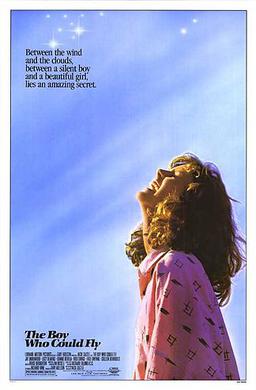
I'm going out on quite a limb for February's Underrated Movie of the Month (MOTM). Of all the movies I've featured so far, this is far and away the one that I haven't seen in the longest time: more than 20 years. But there are no rules to this feature (the word "underrated" shouldn't be taken too literally; many of them have at least a 50% RT rating), and since a friend of mine and I spontaneously and independently thought of this movie the other day, here it is: The Boy Who Could Fly.
It was interesting thinking back on what I remembered and appreciated from this movie since seeing it in the theater as a young boy. Turns out the most lasting image in my head is that of a little kid (who I now assume to be a young Fred Savage) jetting around on a plastic tricycle and exacting revenge on the bullies down the street by ambushing them with a water gun filled with his own urine. Whether this happened in The Boy Who Could Fly or actually in some crazy dream of mine is for you to tell me or me to find out at a later viewing, but let's assume say that this does happen in the movie, and that it's reason enough for it to be celebrated.
Written and directed by Nick Castle (whose career peaked with The Last Starfighter in 1984 and essentially ended with Major Payne in 1995), The Boy Who Could Fly tells the story of Eric Gibb, an extremely withdrawn autistic teen who lives with his negligent, alcoholic Uncle Hugo. (Making matters worse, his uncle is played by Fred Gwynne, otherwise known as Herman Munster from "The Addams Family".) Eric's parents died in a plane crash, and he grieves by standing on his roof and stretching out his arms as if about to take flight. When Milly (Lucy Deakins) and her brother Louis (Savage) move in next door, she strikes up a friendship with Eric that not only brings him out of his shell, but also leads to a tender romance. Incidentally, I've just now realized Eric was played by Minneapolis native Jay Underwood, who just three years later would achieve movie immortality as Bug in Uncle Buck.
I know what you're thinking, because it's what anyone would naturally conclude: Milly only becomes interested in Eric when she learns that he can fly. Now what kind of message would that send? Like most teen crushes, her attraction to him is innocent and gradual until it really takes flight when, well, Eric takes flight with her in tow. It's obviously not the most believable of premises, but there's something heartwarming about their friendship that I wish was still present in today's teen romances - on screen and off.
Unfortunately, The Boy Who Could Fly could simply not be produced in the present day because the 80's-ness is completely off the charts. It is truly a movie that could only exist at one moment in time, as evidenced by a trailer that must be considered one of the worst of the entire decade:
Additionally hampered by an atrocious poster (shown above, here's a close-up) and the fact that it probably resembled a classic 80's After School Special to anyone who saw the trailer, it's no wonder The Boy Who Could Fly didn't fare very well at the box office with a total domestic gross of just over $7 million (although it would be far to say that amount would cover the cost of the cheesy special effects). Reviews were mostly positive at the time (Roger Ebert praised it as a "sweet and innocent parable"), but in the years that have passed it's been taken to task for "heavy-handed emotional manipulation and an escapist conclusion" (Time Out New York).
Call it what you want to, but for those of us who grew up in the 80's, The Boy Who Could Fly is the kind of family-friendly romantic dramedy that will always hold a special place in our memories. It didn't rely on potty humor (hmm, nevermind the urine attack) or past-their-prime stars looking for a quick paycheck, and it was bold enough to responsibly and respectfully confront serious issues (autism, alcoholism, death, etc.) without . Of course I say this without having seen the movie in more than two decades, but I really think it positively influenced me a subconscious level, and from what I've heard I'm not the only one.
January's Underrated Movie of the Month harkens back to a time when the markets were strong and the crooks were, well, nobody really cared about the crooks because the markets were strong. Remember, 10 years ago, when the Dow was peaking at all-time highs and the internet bubble hadn't yet popped?
Near the end of this fattened-calf period came Boiler Room, Ben Younger's surprisingly still relevant drama that both glamorized and criminalized the free-wheeling lifestyle of a group of sneaky New Jersey stock brokers at the fictional investment firm JT Marlin. Younger (who has unfortunately done little of significance since Boiler Room) was planning a career in politics until he accompanied a friend to a recruiting session (similar to the one lorded over by Ben Affleck in the film) and came up with an idea for his first screenplay.
In an interview for New York Magazine, Younger, then 27, explained: "I walked in and immediately realized, this is my movie. I mean, you see these kids and you know something is going on. I was expecting guys who went to Dartmouth, but they were all barely out of high school, sitting in a room playing Game Boys. I had already run a campaign at this point, but most of these kids were still working at the gas station," says Younger. "Now it's all over the news, but going back five years ago, day trading, the Internet, none of that existed."
Of course today, almost a decade after the film was released, day traders aren't the newsmakers - despite the astonishing rise of "Playing the Stock Market for Dummies"-type manuals. Indeed we've come full circle, and investment firms and executives are once again the big bad bullies of Wall Street, ironic considering that at least in the public eye, Boiler Room seemed to mark the end of greedy stock brokers as we knew them from the Gordon Gekko-in-Wall Street days. Turns out these wannabe Scrooge McDucks lived the extravagant life right up until credit and credibility ran dry over the last 18 months.
And we were all on our way to early retirement with them, borrowing what we couldn't pay back and making risky investments in search of the highest short-term return we could possibly find. Unfortunately for us (and I loosely use the term; I've never had spare change to play around with), Boiler Room primed a generation of hungry brokers just waiting to hook us up with the "easy money". The dialogue from the movie appears to be ingrained in many of the people on the other end of our phone line, or so it would appear based on memorable quotes popping up in a mortgage broker forum I just happened across (from April of 2008, eerily titled "Lehman Brothers going down soon?").
But does a prescient movie make an underrated one? Not necessarily, but for also featuring a tense and believable screenplay and a remarkably talented young cast, Boiler Room rarely gets the respect it deserves. One of the cool things to do, for example, is criticize it as a rip-off of Wall Street or Glengarry Glen Ross. But on closer examination, with dialogue from those two classics deliberately used and obviously referenced (and in the case of Wall Street, actual clips of the movie shown), it would seem to me that Younger clearly knew his audience and acknowledged their influences. And based on the aforementioned fact that his dialogue is now being used by young brokers, I would argue that his material was plenty original.
One of the best scenes comes about halfway through Boiler Room, when Seth (Giovanni Ribisi) has finally gained enough confidence to shrewdly push a sale on a reluctant buyer (Taylor Nichols). It's uncomfortable and nauseating, mostly because we know how easily and often it happens every day. Observe:
Naturalistic conversations like this permeate the movie and are surprisingly well acted by an eclectic cast that includes Vin Diesel, Ben Affleck, Nicky Katt, Scott Caan, Nia Long, Jamie Kennedy, Ron Rifkin, Tom Everett Scott, and of course Ribisi. How his career has tanked so much in the last five years is a complete mystery to me - can you name his last movie? After a decent 2003 (Cold Mountain, Lost in Translation), he had a bizarre 2004 (Flight of the Phoenix, Sky Captain and the World of Tomorrow) and then...nothing - at least nothing worth mentioning. Hopefully, 2009 will mark a major return for this talented actor. He's currently attached to six projects on IMDb, two of which are among the most anticipated movies of this entire year: Michael Mann's Public Enemies and James Cameron's Avatar.
Ribisi never really blows you away with his acting, but the more you see his work the more you start to appreciate the small things, as is the case with this movie (i.e., the soundtrack). Of course there are missteps here and there, with a meandering father/son storyline and an unnecessarily heroic ending, but on balance Boiler Room is a taut and engaging film that deserves to be appreciated more in the context of our current economic climate.
December's Underrated Movie of the Month (MOTM) left a major impression on me upon first viewing. The genre of "martial arts action flick" is not one that I've ever gone out of my way to explore, but after seeing Rumble in the Bronx in 1996, I made sure to keep an eye on the career of Jackie Chan.
Yes, he was already a massive star in his native Hong Kong well before 1995, but Rumble in the Bronx finally brought him to mainstream American audiences, which aside from sending his paycheck through the roof, also served to significantly influence martial arts action in many American movies that followed it. After Rumble in the Bronx, no longer were we satisfied with Jean Claude Van Damme's roundhouse kicks, Wesley Snipes' wide-eyed brawling or Steven Seagal's stone-faced scuffling. We wanted our fighting to be entertainment, with ever more imaginative props and ever more ambitious stunts.
Those who were already familiar with Chan's work in the 70's and 80's must have been thrilled to see American audiences eat up his frenetic fighting style, even if it was in a movie that admittedly plays like a parody of itself half of the time. The dialogue is cringe-inducingly cheesy and the bare bones plot (Chan's character visits New York to attend his uncle's wedding) features an unnecessary number of twists . The attempts at romance are laughable (which I think was the point) and the set pieces absolutely scream "early 90's"; it would be hard to find anything in this movie outside of the action that hasn't dated terribly. In his pan of the movie, the New York Times' Stephen Holden likened the production design to "a candy-colored battleground that looks even more garishly fake than the set for Michael Jackson's 'Beat It' music video." Can't argue with that (remember when Michael Jackson was relevant?...sigh...). In the San Francisco Chronicle, Mick LaSalle also rails against the setting, charging that the movie " throws Chan into the middle of an unrecognizable, cartoonlike version of America, then makes him look silly by forcing him to take it all too seriously." LaSalle also makes a valid complaint that Rumble in the Bronx "gives [Chan] little opportunity to show his exuberant personality", which wouldn't have occurred to me at the time but makes plenty of sense now considering his winning charm in movies like Rush Hour and Shanghai Noon.
So I concede that the story and production are passable at best. That the evil street gang prowls around on flashing (and numbered, as if in a race?) dirtbikes and ATV's is ridiculous, and so is the fact that numerous times during the movie it becomes painfully obvious thatRumble in the Bronx was not filmed anywhere near the Bronx (it was shot entirely in Vancouver, British Columbia). But no matter what other problems you have with this movie, it's almost impossible to complain about a lack of energetic action. Our first real taste comes early on, when Keung (Chan) confronts some rowdy gang members in his uncle's store (watch the clip here). It's a perfect introduction to the Jackie Chan that America would grow to love - the action star often considered a combination between Bruce Lee and Buster Keaton.
From that point on, Rumble in the Bronx is an exercise in patience and optimism. If you don't get caught up in the flaws, you'll be rewarded with action sequences that have the slapstick choreography of a silent comedy and the physical prowess of the best martial arts movies. It's not entirely clear to me why such salty language was used in this movie, which a.) makes the over-dubbed dialogue sound even more awkward, and b.) earned the movie an unnecessary "R" rating, which may have kept a sizable number of action-hungry American teens out of the theater.
The distribution details in general of Rumble in the Bronx are puzzling. Filmed in 1994 and titled Hung fan au, the movie played throughout Asia in 1995 before being re-dubbed, re-edited and retitled for an American release in 1996. The eventual $30 million box office take wasn't the success some may have hoped for, but it's probably the only reason Jackie Chan got another star-making opportunity opposite Chris Tucker in Rush Hour. Additionally, it opened the doors for several of his older movies to make their way into American theaters for the first time, including the last two installments of his Police Story franchise: Supercop and Jackie Chan's First Strike.
In watching parts of Rumble in the Bronx online recently, I realized that since 1996, the only non-computer generated action in movies that left me slack-jawed upon first viewing was Tony Jaa's stunt work in Ong-Bak (some of the highlights can be seen at the end of the trailer and in the ridiculous chase scene). Both Chan and Jaa stunned me with their physical feats - running up walls, squeezing through holes, leaping over cars, and so on. These would have been plenty impressive on their own, but considering these stars do all of their own stunts, some of the scenes become absolutely unbelievable (observe Chan in Supercop, impossibly dangling from a helicopter ladder above Kuala Lumpur without any kind of safety harness).
Alas, there have been some rumors that director Stanley Tong, himself an experienced martial arts expert and stuntman, is actually the one we see in several of the most dangerous scenes in Rumble in the Bronx. It's up to the viewer to believe this (I see Chan when watching the clips) or dismiss it, or to think it matters anyway. Either way, I'm confident this movie helped raise the bar for action and martial arts movies that followed it. Stephen Holden was curious about this possibility in his review: "If 'Rumble in the Bronx' scores well enough at the box office to make Hollywood see major dollar signs, it could augur a new style of action-adventure film in which swaggering macho pyrotechnics give way to balletic daredevil comedy."
I don't know if there have been many movies that clearly qualify as "balletic daredevil comedies", but the last decade has certainly seen new interest in balletic (Crouching Tiger, Hidden Dragon, The Matrix trilogy, the success of Jet Li movies), daredevil (Daniel Craig and Matt Damon doing their own stunts in Bond and Bourne, respectively), and comedy (the Rush Hour franchise by itself has earned nearly $1 billion at the box office).
My evidence of the influence Rumble in the Bronx may be limited to those examples, but I think Jackie Chan can nonetheless be given some credit for changing the action game in Hollywood. Maybe this clip will make my point more persuasively:
November's Underrated Movie of the Month (MOTM) again comes from 1998 (which is apparently in a duel with 1996 for the title of Most Underrated Movie Year of the 90's). Known as the last great film from John Frankenheimer, Ronin is also famous for featuring what's arguably considered the greatest car chase ever filmed. I hesitate to use the word "arguably" because it's not really a debate. It's the best chase ever - period.
Sneaking into theaters in September of 1998, Ronin was immediately submarined by the box-office monster Rush Hour, which opened the week prior and took no prisoners on its way to becoming a smash hit. I'd have to reference my ticket stub collection (yeah, I have one) to determine when I first saw Ronin, but it was definitely in the theater that fall because I remember how awesome my friends and I all thought it was.
Unfortunately, we differed from a number of stuffy critics. Writing in New York Magazine (before he became a critic for The New Yorker), David Denby lamented the nonsensical plot, ultimately calling Ronin "an act of connoisseurship for people who have given up on movies as an art form." In the Washington Post, Michael O'Sullivan compared it to "a high-brow Steven Seagal film, with massive gun battles that casually disregard civilian casualties and too many overlong car chases through the twisty streets of Paris and Nice." He even went on to chastise Frankenheimer for filming a car chase in the tunnels of Paris because it was "unnervingly reminiscent of a reenactment of Princess Di's demise." Come on. Reminds me of the "R" rating the MPAA slapped on Changing Lanes in 2002 because the World Trade Center towers could be seen in the background of a few scenes.
Is Ronin a classic crime caper for the ages? Maybe not. The plot is unnecessarily convoluted (Russian and Irish splinter groups are after a mysterious silver suitcase), there's not much character development and the finale is mostly lackluster. But all of these flaws make it merely good instead of excellent, and the action bumps it back up to at least a respectable level of greatness. The star-studded cast, which includes Robert De Niro, Jean Reno, Stellan Skarsgård, Sean Bean, Natascha McElhone and Jonathan Pryce, has been overlooked for far too long. While none of them turn in award-winning performances, they each perfectly fit their roles, and De Niro especially does well as the nucleus of the story. His do-it-yourself surgery following a gunshot wound may be a chore to sit through, but at least it's followed by a clever line: "If you don't mind, I think I'm going to pass out now."
Sounds a bit like David Mamet, doesn't it? I mean he rea- what's that? Mamet wrote the screenplay? But the credits list J.D. Zeik and Richard Weisz? Ah, I see. Mamet was so upset about sharing a screenwriting credit with Zeik (who created the story) that he refused to lend his real name to the film's credits. Politics aside, Mamet's sharp writing makes for some pretty entertaining dialogue - unusual for your average crime drama. Instead of rolling your eyes at typically predictable lines, you actually find yourself interested in the conversations even when you have no idea what the characters are talking about.
Ironically, however, the scenes without dialogue are the highlights of Ronin. Frankenheimer lets fast cars and big guns do the talking in several outstanding action sequences, all filmed on location in various French cities. Hundreds of stuntmen and stunt drivers were employed on the film, giving it an air of authenticity that you just don't see these days (some Bourne sequences and the opening of 2006's Casino Royale are maybe the last best examples). Why go through all that trouble choreographing long action sequences when you can use green screens and CGI? I'll tell you why - your car chases won't be nearly as impressive as those in Ronin. Like its peers in Bullitt and The French Connection (curiously, Frankenheimer directed The French Connection II), the chases in Ronin are long affairs that continue to build tension with every thrilling second. I'm not taking anything away from those masterful sequences - and they are masterful - but neither chase is as downright complicated as this one (watch it with full volume in full screen mode for the best experience):
This clip, in addition to an earlier chase scene in Nice (you'll have to rent the movie to see that one), completely changed the game for Hollywood car chases. Many have since tried to beat it (the Matrix Reloaded, the Bourne movies,the Bond movies, The Fast and The Furious, etc.), but they don't come close to achieving the gripping realism of the Paris chase, and it may be years before any movie does. Notice the lack of music during the first three minutes. The perfectly choreographed traffic, impossibly timed crashes and breathtaking near-misses. The first-person and behind-the-driver camera angles. The lack of silly tension-breakers ("Oh, whoops - sorry!"; "Hey, my caaaar!"). The seamless editing, and even the great acting by the drivers and passengers. On first viewing, about the only noticeable flaw in the chase (aside from the eventual use of music) is the fake-looking entry into the final tire blowout/rollover, but Frankenheimer can be forgiven for wanting to make it look like the actors were actually in the car.
It's a stunning seven minutes, and experiencing it in the theater was a thrill comparable to taking a BMW for a test drive. Speaking of which, that's exactly what legions of people would do years later when BMW released its brilliant marketing campaign, officially known as The Hire but informally known as the Best Car Commercials Ever Made. Eight short films featured Clive Owen driving people around in BMWs from different model series. The actors (his passengers) were Hollywood stars, and each of the films was directed by a different filmmaker, including Ang Lee, Alejandro González Iñárritu, Wong Kar-wai, and Guy Ritchie. And, at the helm of the very first of the eight films, The Ambush, was none other than John Frankenheimer, master of the car chase. It would be one of the last films directed by Frankenheimer before his death following a stroke in 2002. Looking back on his filmography, it's truly a shame that two out of his last three movies can be considered among the worst of the last decade and a half. Both The Island of Dr. Moreau, which immediately preceded Ronin, and Reindeer Games, which immediately followed it, are abominations. In fact if it wasn't for Ronin, you might have to go back to the 70's to find anything respectable by Frankenheimer, whose greatest career achievement was probably The Manchurian Candidate in 1962. He may not have been an Oscar-worthy director (he was never nominated in nearly four decades of work), but with Ronin he's left his legacy by influencing every car chase we've seen in the last 10 years.

 "Is there a national championship collegiate athletic program anywhere in the country that can truthfully say all of its recruiting was done entirely within the official guidelines? Just asking."